|

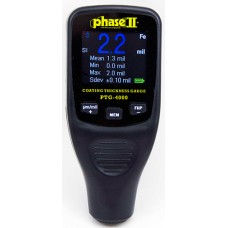
PTG-3500 with Integrated Probe
On-Sale at only $445
. Measuring range: 0-2000 µm max. or 0-80 mils
. Resolution: 0.1µm / 0.01mils (0-99µm) or 1µm (over 100µm)
. Guaranteed tolerance:
After one-point calibration: +/- 1-3%n or 2µm (whichever is greater)
. Display: 4 digits (digit height = 10mm/0.4")
. Min. measuring area: 0.2" x 0.2" (5mm x 5mm)
. Min. radius of curvature: Convex: 0.12" (3mm)
Concave: 1.2" (30mm)
. Min. substrate thickness: Ferrous: 20 mils (0.5mm)
Non-ferrous: 2 mils (50 µm)
. Calibration: Zero Calibration,
Foil calibration
. Max Surface temperature of test object: 302 degrees F (max contact time 2 seconds)
. Power source: 4 AA batteries
. Dimensions: 161 x 69 x 32mm (6.33 x 2.72 x 1.26")
. Weight: 9oz. (260g)
 |
PTG-3550 with External Probe
On-Sale at only $445 |
|
Non-Destructive Coating
Thickness Measuring Principles
1) Magnetic Induction
Priciple:
The Phase II PTG series of Coating Thickness Gauges utilize this
non-destructive priciple when measuring coatings on ferro-magnetic
substrates such as Steel and Iron. The coatings must be non-magnetic such
as; paint, enamel, aluminum, chrome, copper and brass.
2) Eddy-Current Priciple:
The Phase II PTG series of Coating Thickness Gauges utilize this
non-destructive priciple when measuring coatings on non-magnetic
substrates such as; Aluminum, Aluminum Alloys, bronze, copper, brass tin
and rustproof weak magnetic steels. The coatings must be electrically
insulating such as; paint, enamel, plastics, anodized coatings and
ceramics.
Calibration Procedures
NOTE: All PTG series Coating Thickness Gauges are inspected and
calibrated using the Two-Point Calibration procedure prior to shipment.
1) One-Point Calibration:
This procedure is accomplished by "Zeroing" the gauge on an uncoated
version of the sample that you will be checking the coating thickness on.
To accomplish this calibration, you will need to follow the simple
calibration procedure that is explained in the operation manual. Although
this is an accurate method for calibration, it is not as accurate as using
the two point calibration.
2) Two-Point Calibration:
This procedure is accomplished by "zeroing" the gauge on one of the
supplied substrate samples (steel/aluminum) and then placing one of the
calibrated "foils" on that substrate and calibrating the gauge to match
the known thickness of the foils. It is best to use the foil that is
closest to the actual known thickness of your own samples to be tested.
This is a very simple procedure that is explained in the operation manual.
By using the two-point calibration procedure, you are making sure that the
gauge will be at its most accurate when testing your own coated samples.
This is the same method used to calibrate every gauge prior to shipment.
3) Frequency of Calibration:
Once the PTG series of Coating Thickness Gauge have been calibrated, the
parameters are saved in the memory and the calibration procedure does not
need to be repeated. We do recommend that after numerous hours of
operation or if the gauge has not been used for a few days you should
check the accuracy using the same calibrated substrate/foil combination
previously used to calibrate the gauge.
Return to BUY NOW page |